Sep 17, 2026Applications
Component Selection for Quick-Change Fixtures & Equipment
A practical guide to selecting locating, locking and quick-release components for faster changeovers, with focus on grip length, receiver interfaces, access and repeatable reinstallation.
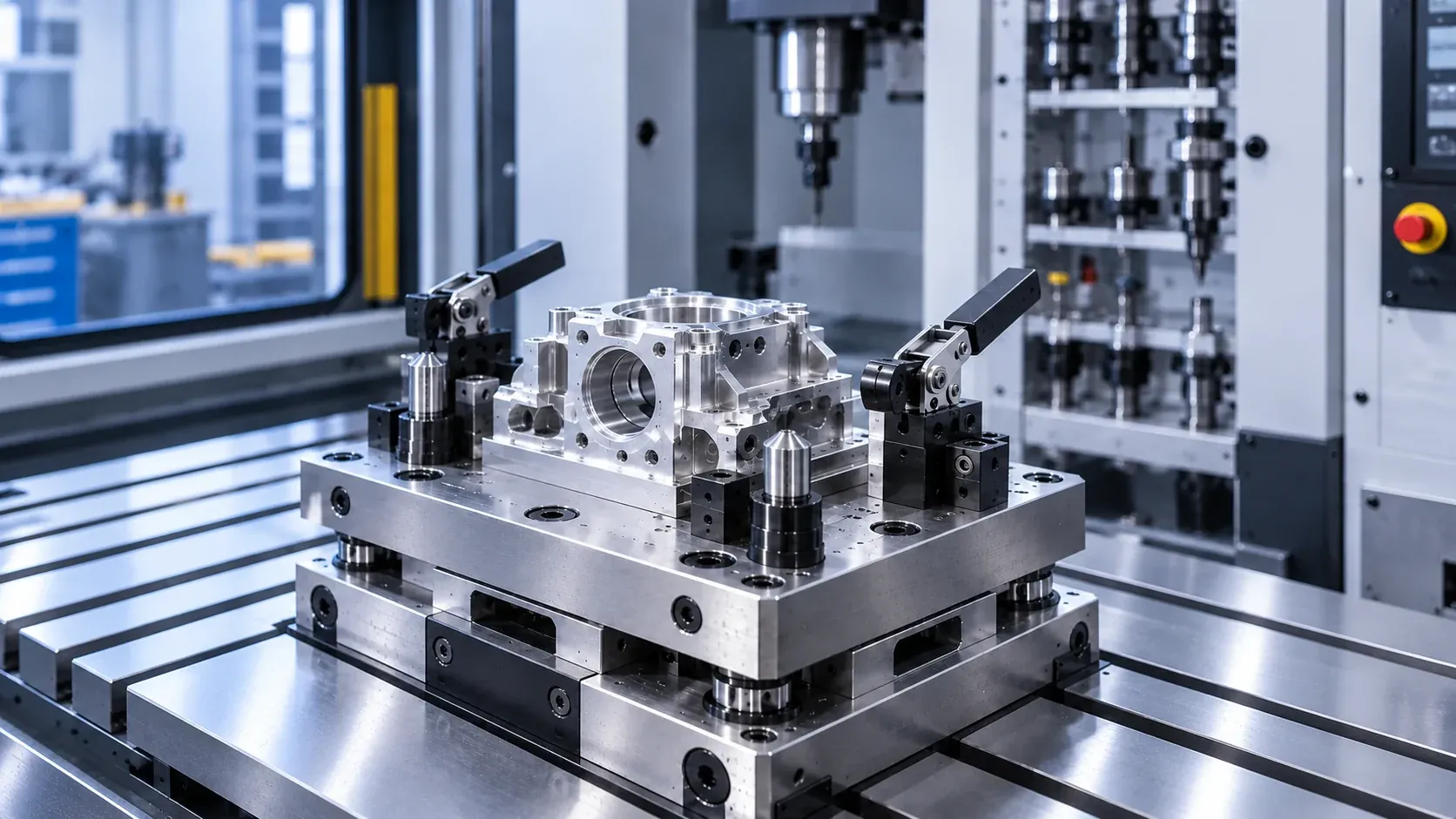
Component Selection for Quick-Change Fixtures & Equipment
A good quick-change system does more than make a component faster to remove.
After a fixture plate, machine module, guide or tooling element is changed, it still needs to return to the intended position, remain securely retained during use and release without unnecessary tools or adjustment.
That means changeover should be considered as a sequence:
Locate → Retain → Release → Replace → Relocate
Problems occur when only the release step is optimized.
This guide explains the main factors to consider when selecting locating, locking and quick-release components for fixtures and equipment that are changed regularly.
1. Start by identifying what makes the changeover slow
Before replacing conventional fasteners with quick-release hardware, look at the complete changeover process.
Time may be lost because operators must:
- remove several threaded fasteners;
- use tools in restricted spaces;
- manually realign the replacement fixture;
- measure or adjust the position after installation;
- reach difficult retention points;
- search for loose hardware;
- repeat adjustments before production can restart.
Each problem requires a different solution.
A ball lock pin or quick-release pin can reduce the time required to retain and release a component, but it will not automatically solve an undefined locating interface.
Likewise, precision locating features can help a fixture return to position, but they do not necessarily make removal faster.
The first step is therefore to separate where time is being lost from which component should be changed.
2. Separate locating from retention
One of the most important questions in a quick-change design is:
What establishes position, and what holds the assembly together?
These may be separate functions.
For example, a removable tooling plate can use dedicated locating features to establish position while a quick-release component provides retention.
In other designs, a purpose-built system may combine locating and clamping functions through matched components.
The important point is not to assume that every retention pin is also a precision locator.
When repeatable reinstallation matters, review the complete interface:
- primary locating feature;
- secondary locating feature, where required;
- retention method;
- mating receiver or bushing;
- release method.
This makes it easier to diagnose whether a changeover problem comes from positioning, retention or release.
3. Why does grip length matter for a ball lock pin?
For a ball lock or quick-release pin, diameter alone is not enough to define the required size.
Grip length describes the effective thickness or distance through the parts that the pin must pass through and retain.
If the selected grip length does not match the assembled interface, the locking elements may not engage where intended or the installed condition may not match the design requirement.
Before specifying a pin, identify:
- total thickness of the retained assembly;
- location of the locking feature after insertion;
- required pin diameter;
- mating hole or receiver geometry;
- any variation in assembled thickness.
Standard ball lock pins are commonly offered in multiple grip lengths, which is why grip length is a basic ordering parameter rather than a secondary detail. Carr Lane, for example, structures its standard ball-lock pin configurations around both diameter and grip length.
If the assembly thickness varies, do not simply choose a longer pin without reviewing how the locking mechanism will engage.
4. Review the receiver or bushing as part of the system
A quick-release pin does not operate in isolation.
The mating hole, receiver or bushing affects how the pin enters, where the locking elements engage and how repeated use affects the surrounding structure.
A dedicated receiver or bushing can be useful when:
- the interface is used frequently;
- the base structure should not become the primary wear surface;
- a defined mating geometry is required;
- serviceability matters;
- the mating component may need replacement.
Purpose-built quick-change systems illustrate why this matters. Carr Lane's Carr Lock system, for example, uses matched clamp, liner-bushing and receiver-bushing components rather than treating the locking element independently.
The exact interface will depend on the component design, but the general selection principle is the same:
Review the pin and mating interface together.
5. Consider access before choosing the release style
A quick-release mechanism is only quick if the operator can actually reach it.
Before selecting a handle or actuation style, check:
- available hand clearance;
- direction of removal;
- nearby guards or machine frames;
- whether gloves are normally worn;
- whether the component is accessed from above, below or from the side;
- whether several pins must be operated during one changeover;
- whether loose pins need to remain attached to the equipment.
Ball lock pins are available with different handle configurations because access and actuation conditions vary. Carr Lane's current product range, for example, includes L-handle, T-handle and ring-handle versions with multiple grip lengths.
The most convenient handle on an open bench may not be the best choice inside a machine enclosure.
Select the actuation method from the installed environment, not from appearance alone.
6. Design for repeated removal, not just the first installation
A fixture that is removed once a year and one changed several times per shift should not automatically use the same interface.
For frequent changeover, review:
- wear at the pin and mating interface;
- contamination around locating surfaces;
- ease of visual inspection;
- whether bushings or receivers are replaceable;
- whether pins can be lost after removal;
- whether the operator can reinstall the fixture incorrectly;
- how the locating surfaces are protected when the fixture is absent.
Repeated insertion and removal make maintainability increasingly important.
A component that saves a few seconds during release but creates difficult alignment or premature wear can increase total downtime rather than reduce it.
7. Keep quick change and repeatable location as separate requirements
Fast removal and repeatable reinstallation are related, but they are not the same engineering requirement.
A fixture may release very quickly and still require manual realignment after every change.
If repeatable relocation matters, the design needs a defined locating strategy.
For tooling plates located from two points, for example, a round and diamond locating arrangement can establish location while accommodating small center-distance variation and reducing the risk of binding. Carr Lane uses this principle specifically for locating quick-change tooling plates and vises.
The quick-release or retention hardware can then be selected around that locating strategy.
This is why a successful quick-change interface should be evaluated as a system rather than as a collection of individual pins.
8. Common quick-change problems to check
The fixture releases quickly but takes too long to reinstall
The release hardware may be working correctly while the locating strategy is inadequate.
Review what establishes the fixture position after replacement.
The ball lock pin fits the hole but does not retain the assembly correctly
Check the required grip length, assembled thickness and mating interface rather than evaluating pin diameter alone.
Operators still need tools during every changeover
Identify which operations actually require tools. A quick-release component only reduces changeover time if the remaining fasteners and access requirements do not become the new bottleneck.
The pin is difficult to operate inside the machine
Review handle style, pull direction and surrounding clearance.
The problem may be accessibility rather than the locking mechanism itself.
The mating holes are wearing
Review cycle frequency and whether a replaceable receiver or bushing should become the serviceable wear interface.
The replacement fixture does not return to the same position
Separate retention from location. A quick-release pin should not automatically be expected to establish the required positioning accuracy.
9. What should be included in a quick-change component RFQ?
For ball lock pins, quick-release pins, receivers or related changeover components, provide as much of the following information as available:
- component type or existing part number;
- drawing or dimensional sketch;
- pin diameter;
- required grip length;
- total assembled thickness;
- mating hole, receiver or bushing information;
- mounting arrangement;
- preferred actuation or handle style;
- available operating clearance;
- expected changeover frequency;
- material requirement;
- quantity;
- whether the component replaces an existing part.
For an existing assembly, photographs together with dimensions, drawings or the current part number can help identify the required configuration.
For a new design, describe both the locating requirement and the release requirement rather than specifying only a pin size.
10. Choose the component by the changeover problem
A practical selection sequence is:
Need fast manual installation and removal?
Review Ball Lock Pins or Quick-Release Pins.
Need a defined mating or serviceable interface?
Review the appropriate Receiver or Bushing.
Need repeatable positioning after every change?
Add a defined Locating Pin / Locating Bushing strategy rather than relying only on the release hardware.
Need to locate from two points without unnecessary constraint?
Review a Round & Diamond Locating Pin arrangement where appropriate.
Need different retained thicknesses?
Review the grip-length requirement carefully and determine whether a fixed or adjustable configuration is appropriate for the actual assembly.
The goal is not simply to replace every bolt with a quick-release pin.
The goal is to remove unnecessary steps while preserving the positioning and retention functions the equipment actually requires.
Reduce changeover time by designing the complete interface
Effective quick change comes from coordinating three functions:
Locate accurately. Retain reliably. Release efficiently.
Start by mapping the current changeover sequence and identifying where time is lost.
Then define the locating interface, retention method, grip length, mating receiver and operator access before selecting the individual components.
If you have an existing pin, drawing, tooling plate or changeover assembly, send the part number, key dimensions or drawing for component review and quotation.